stripCHORDer:LIVE! Ko-fi ♥

Browser extension · Chrome · Edge · Firefox · v1.95

See the chord before you hear it.

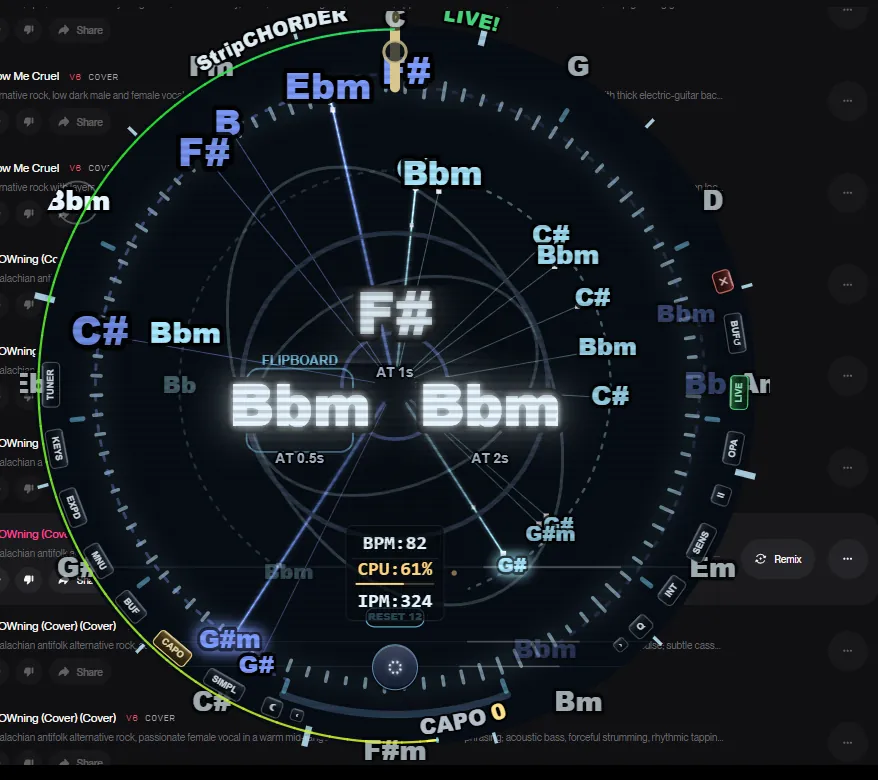
stripCHORDer:LIVE! listens to the tab you're playing, reads the bass and the treble separately, and puts the chord, key and capo shape on a counter-rotating CRT ring a moment before the sound reaches you. Your hand can already be there when the note arrives.

Free · no account · no trackers · audio analysed on your device

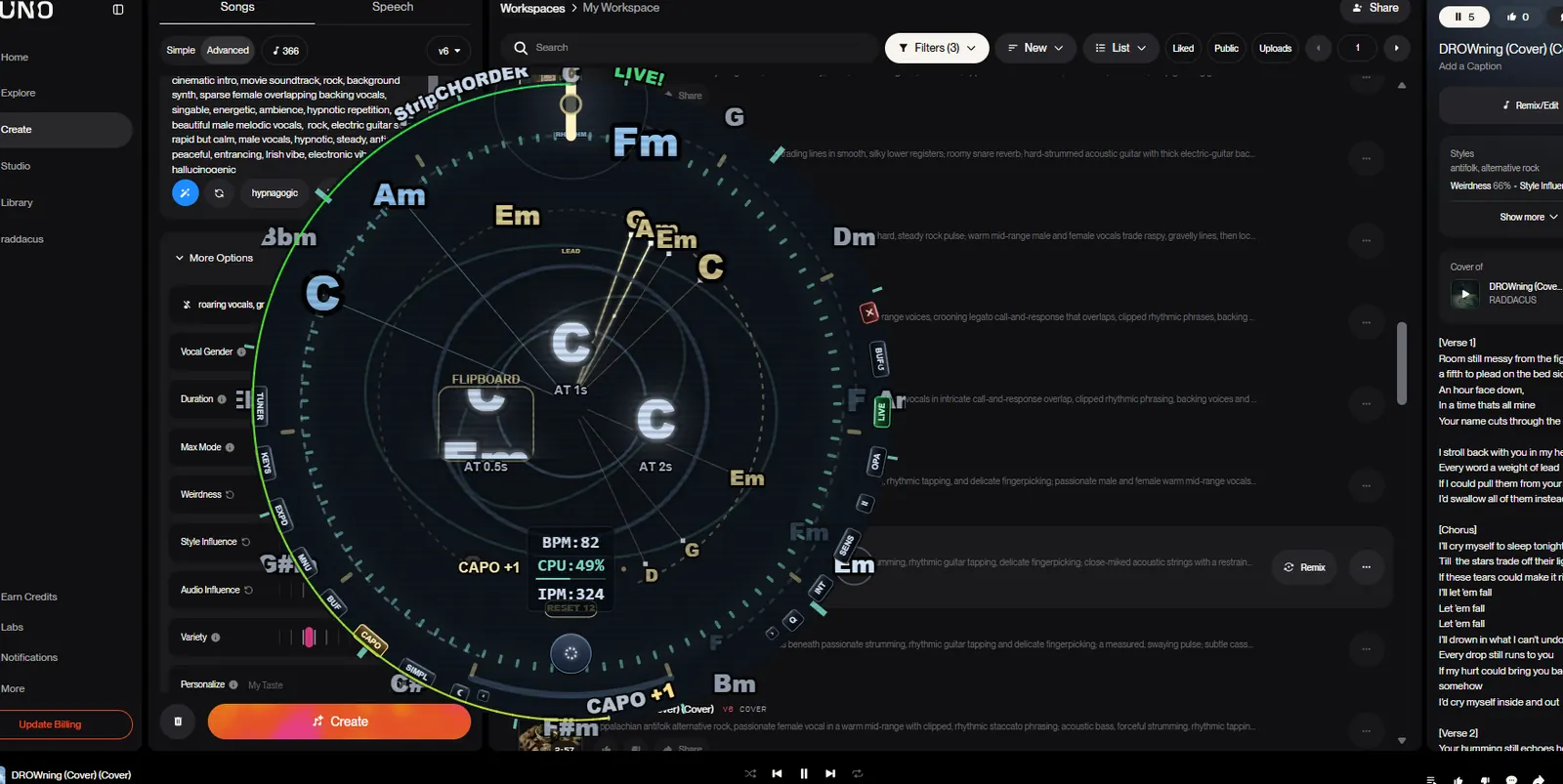
The stripCHORDer:LIVE! ring HUD over a music page: F sharp in the centre with B flat minor at 0.5 and 2 seconds ahead, chord labels orbiting on the outer and inner rings, and BPM 82 in the middle panel
  • 2 bandsbass ≈40–200 Hz · treble ≈200–1200 Hz
  • 108chord templates · 12 roots × 9 qualities
  • Look-aheada real audio delay, 2500 ms shown
  • 0 trackersprocessed locally in your browser

Features · the real extension UI

A chord chart that writes itself while the song plays.

Every screen below is a real capture of the extension running over Spotify, YouTube and Suno. Nothing here is a mock-up.

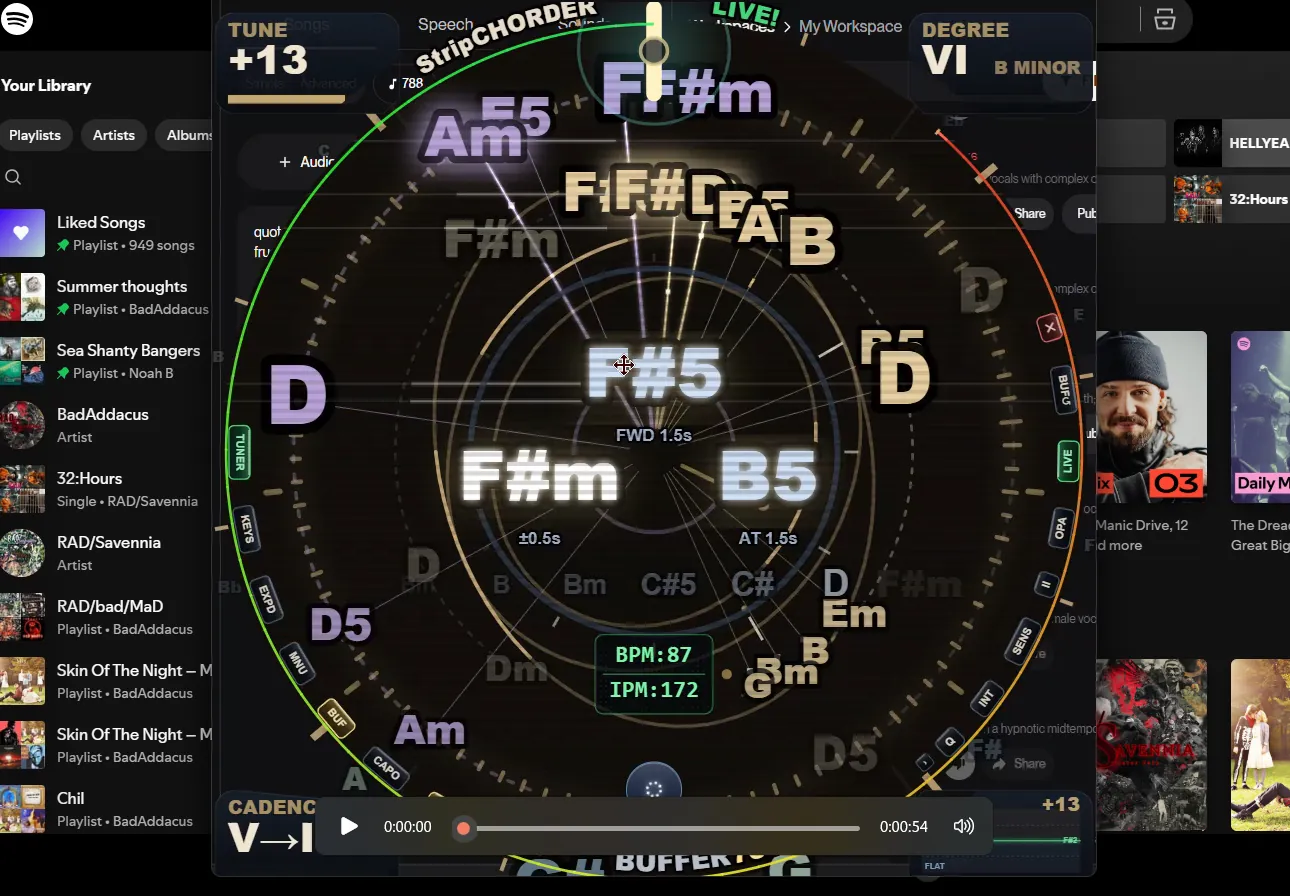
HUD over Spotify with panels reading TUNE +13, DEGREE VI B MINOR and CADENCE V to I around an F sharp 5 chord reading
On Spotify: TUNE +13 · DEGREE VI / B MINOR · CADENCE V→I
01 · DETECTION

Dual-band chord, key and root-motion detection

Bass and treble are read independently, so a walking bass line and the voicing above it don't blur into a single guess. On top of the chord, the HUD tracks the key, the scale degree you're on and the cadence that's moving you there.

  • Separate bass and treble chromas plus a full-range read
  • Key, degree and cadence (for example V→I) panels
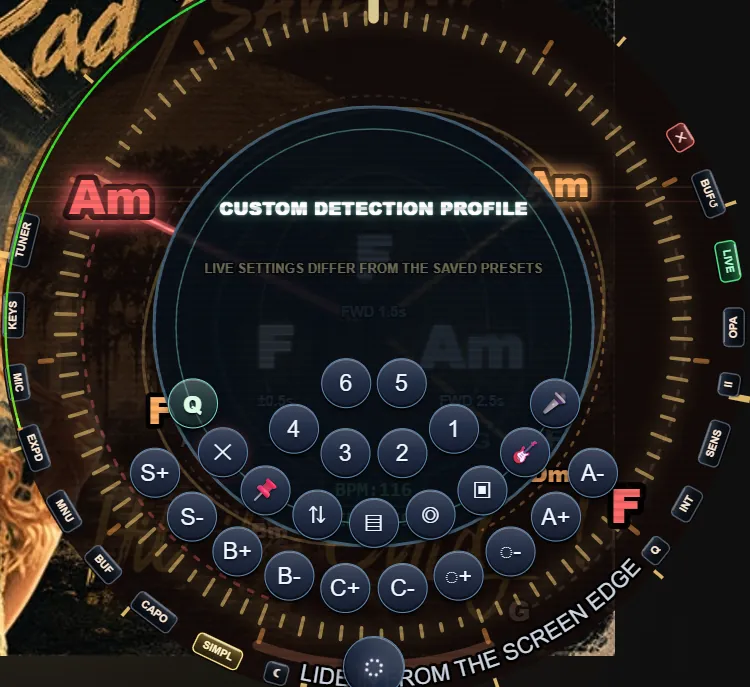
  • Custom detection profiles and sensitivity presets
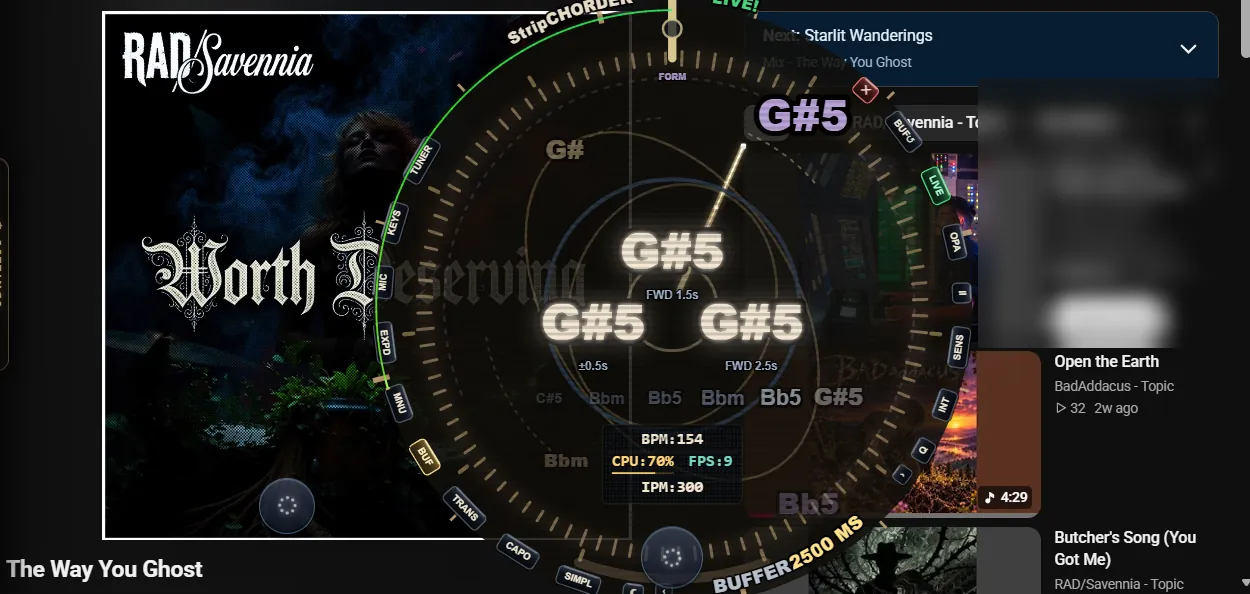
HUD over a YouTube video of The Way You Ghost by RAD/Savennia, reading G sharp 5 at NOW, 1.5 seconds and 2.5 seconds ahead, with BUFFER 2500 MS on the rim
On YouTube: “The Way You Ghost”, RAD/Savennia · G♯5 · BUFFER 2500 MS
02 · THE RING

CRT counter-rotating rings

Bass chords travel one way around the outer track and treble chords the other way around the inner track, so they meet at the NOW mark at the top. The centre gauges show what's coming at 0.5 s, 1.5 s and 2.5 s.

  • A real heads-up buffer: the audio you hear is delayed, the display isn't faked
  • Glass opacity, ring size, text size and colour schemes, adjustable while it plays
  • A slim two-lane bar HUD if you'd rather keep the page clear
HUD over Suno showing C chords with CAPO +1
Suno · CAPO +1
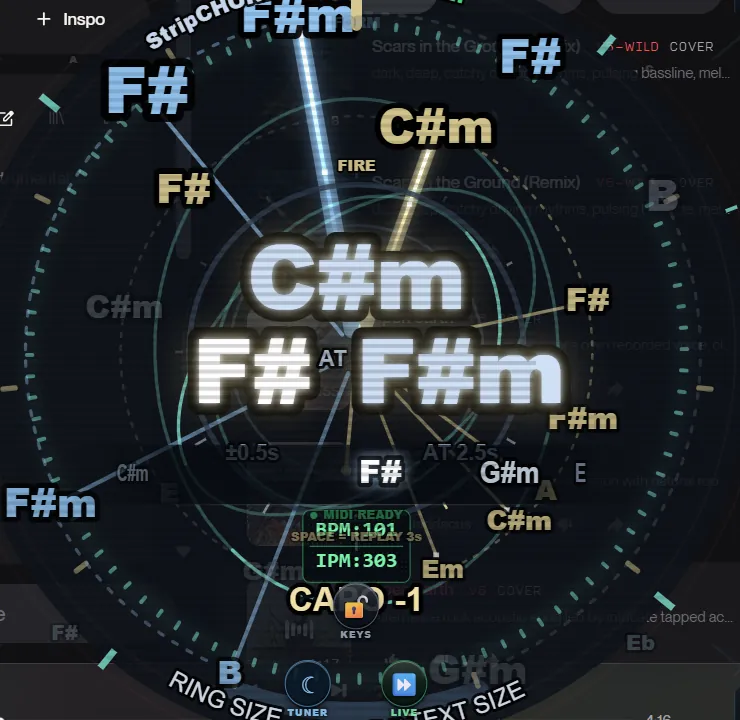
HUD showing MIDI READY, Space equals replay 3 seconds, and CAPO minus 1
MIDI READY · CAPO −1
03 · TRANS + CAPO

Transpose the song. Or just move the capo.

CAPO changes the chord shapes shown, so you see what to fret at any capo position without doing the maths. TRANS shifts the actual pitch of the audio in semitone steps, and the extra processing delay is measured and compensated, so the NOW line still matches what you hear.

  • The TRANS key stays lit red whenever the song is transposed
  • Space replays the last 3 seconds. MIDI output is ready.

Extension only  TRANS isn't in the web demo.

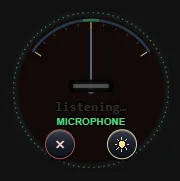
Compact round tuner face reading listening… MICROPHONE
Moon tuner
Radial menu titled Custom Detection Profile, with preset buttons 1 to 6 and plus and minus adjust keys
Custom Detection Profile
04 · CALIBRATE

Calibrate Audio and the tuner

Plenty of records aren't at A440. Calibrate Audio estimates how far a track sits off concert pitch so detection matches the song, not the textbook. The built-in tuner reads the tab, or your microphone if you opt in, and the compact moon tuner keeps out of the way while the music keeps playing.

  • Track tuning offset (for example TUNE +13 cents)
  • The microphone is opt-in and analysed locally
Close-up of the ring: chord names in distinct colours, with B flat minor, F sharp and C sharp each keeping their own colour wherever they appear
Each chord name keeps its colour wherever it lands on the ring
05 · COLOUR

Colour bound to pitch

Each pitch keeps its colour everywhere: on the ring, in the gauges and across capo positions. Over time, “that blue” starts to mean a root before you've read the letters. Eight colour schemes keep bass and treble far apart in hue.

  • Eight schemes, switchable while it plays
  • Bass and treble stay visually separate

Theory · design hypotheses

Why it looks like this.

stripCHORDer is built around four design hypotheses from its creator. They're the intent behind the interface, not proven findings. Read the full theory page.

Counter-rotating channels

Bass and treble run in opposite directions so the brain doesn't merge the two bands' timing into one stream.

Expected-match scanlines

Scanlines mark where a match is expected. They work as non-declarative guides that separate chord structure from the vocal line, so you can play along on a first listen.

Colour permanently attached to pitch

A fixed colour for each pitch builds familiarity that carries across capo positions.

The gauge is always in sync with what you hear

Anything that adds latency, such as transpose, buffering or frame rate, is measured and compensated. The NOW line never drifts from the audio.

How it works

Three clicks to play along.

  1. Play music in a tab

    Spotify, YouTube, Suno, Bandcamp or any tab that's making sound.

  2. Click the icon

    The extension captures that tab's audio and holds a short buffer you haven't heard yet. Tabs you haven't switched on are never touched.

  3. Read ahead, play on time

    Chords and capo shapes land on the ring early. The delayed audio arrives exactly on the NOW line.

Get stripCHORDer:LIVE! · v1.95 · free

Pick your browser.

Live

Chrome

Chrome Web Store, v1.95.

Add to Chrome
Live

Microsoft Edge

Edge Add-ons, v1.95.

Get for Edge
Live

Firefox

Firefox Add-ons (desktop), v1.95.

Get for Firefox
In development

Android

Edge and Firefox for Android are being tested. Chrome for Android doesn't run extensions, so use the web demo there.

Try in browser

Free, no ads, made by one musician. If it helps you play, a coffee keeps it going.

Support on Ko-fi

Privacy in one line

Audio is analysed locally in your browser and never uploaded. There are no accounts, no first-party analytics and no trackers. Read the privacy policy.